
Compare Dickinson County Value Types
Start by naming the number and its record source. Dickinson County's Appraiser estimates market value as of January 1 and reviews recent sales and local economic conditions each year. Kansas assessment rules then classify property and apply a statutory percentage. A deed's consideration reflects a past transaction, subject to the details of that transfer.
| Value type | Meaning | Official record |
|---|---|---|
| Appraised or market value | County mass-appraisal estimate for the valuation date | Appraiser record |
| Assessed value | Appraised value multiplied by the Kansas class percentage | Assessment roll |
| Taxable value | Assessment amount after applicable treatment or exemption context | Tax and assessment record |
| Last sale price | Consideration tied to a past transfer, when available | Recorded deed or validated sale data |
Classification drives the math. Residential real property is assessed at 11.5 percent in Kansas. Commercial and industrial property uses 25 percent. Qualifying agricultural land follows use-value rules instead of ordinary market treatment, so two Dickinson County parcels with similar market estimates can land on very different assessed values because their legal classes differ.
Dickinson County's Annual Value Date
The Appraiser values property as of January 1 and reviews sales plus economic conditions each year. Change of Valuation notices are mailed by March 1 for real property. Those notices show prior and current value and give the owner a defined chance to object.
The value year matters when comparing a roll figure with a deed. A late-year sale may post after the valuation date. Market movement after January 1 also does not turn the earlier assessed value into a current sale forecast.
Kansas Ratios Shape Dickinson Values
State rules sit behind every county number. The Kansas Department of Revenue explains how market, appraised, and assessed value relate, and its classification guidance supplies the statutory percentages while state ratio studies compare appraisal performance across counties.
An assessment ratio is the share of appraised value that becomes assessed value within a class. It is not a market discount. Nor does it predict negotiation in a sale.
Locate Dickinson County Assessed Value
Identify the parcel before reading any numbers. Dickinson County provides address, owner, Quick Ref, tax ID, subdivision, block, lot, and section-township-range paths through its linked property search systems.
- Search the address in the Real Estate Information portal or use Tax History to obtain the parcel key.
- Record the appraised and assessed amounts, property class, and tax or valuation year.
- Check the latest deed at the Register of Deeds when a sale-price reference is needed.
- Compare only like value types and dates. Keep agricultural use value separate from ordinary market appraisal.
- Assessed value
- The appraised amount multiplied by the class assessment percentage.
- Market or appraised value
- The county's mass-appraisal estimate as of its valuation date.
- Assessment ratio
- The statutory percentage used for the property's class.
- Sale consideration
- The amount tied to a transfer, which may need context from the deed.
- Reassessment
- The process of reviewing and updating value for a new year.
Dickinson County Sale Price Context
A sale price is one past transaction. It is not a standing public estimate. The Register of Deeds records each deed. Kansas sales-validation material then helps the appraiser review market activity, while some transfers, such as family transfers or partial interests, are not open-market comparisons at all and can weaken a raw price comparison.
The remote index covers only the most recent 25 to 30 years and is subscription gated. The office public terminal is free. Staff can provide limited access help but do not perform title or valuation research.
Agricultural Value in Dickinson County
Agricultural land gets different treatment. Dickinson County's GIS map samples include agricultural-use parcels, which makes Kansas use-value rules locally important. Qualifying land is valued for agricultural use. It is not valued for the price another buyer might pay for a different purpose. Acres and property type in GIS help identify the tract. The Appraiser still controls classification and value.
Agricultural and residential values do not share a rule. Check class, year, and land treatment before comparing a Dickinson County parcel with its neighbor.
Dickinson County Value Entry
Property value research in Dickinson County begins at the county Real Estate Information portal, the assigned visual entry for the parcel and value lookup.
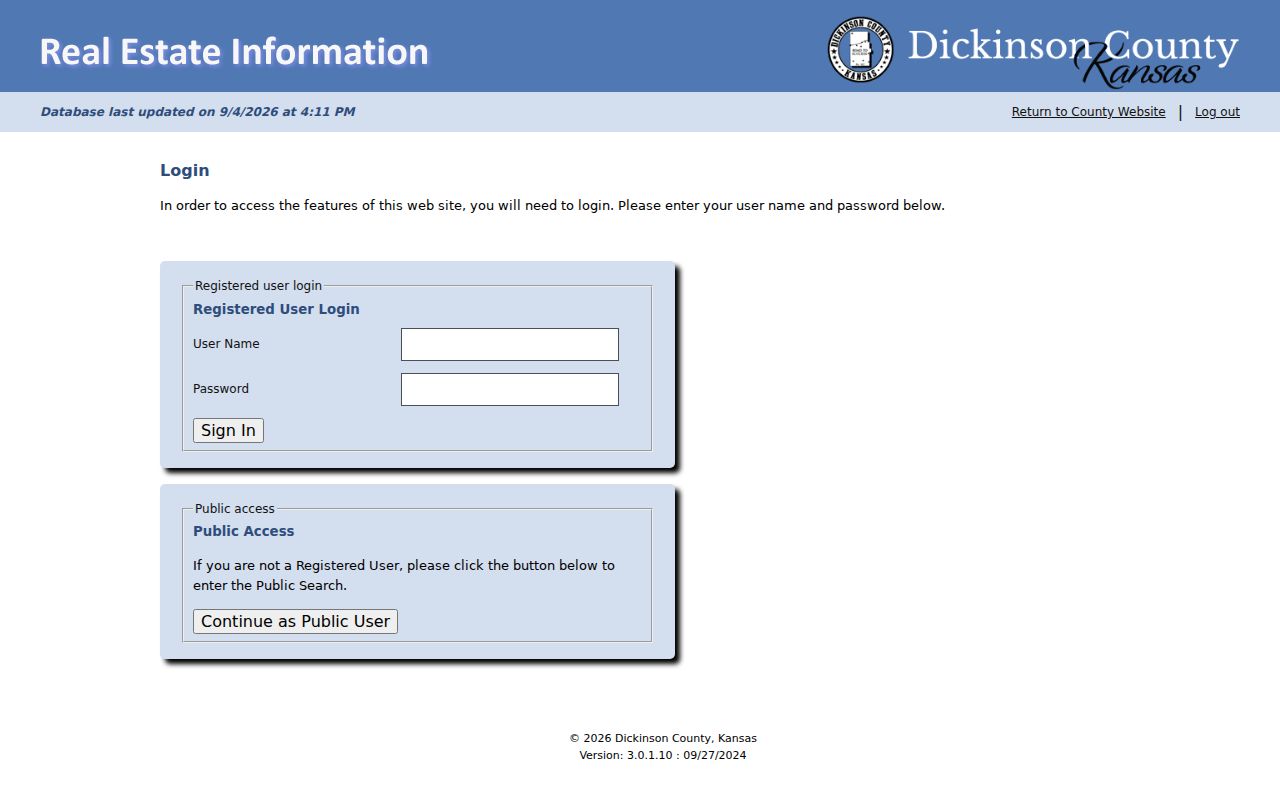
The login screen confirms the official county route. A full parcel-card display appears once a visitor signs in to the property records system.
Limits of Dickinson County Property Value
An assessed value exists to support taxation. An appraised value comes from a countywide mass-appraisal process. Neither is a private appraisal for a deal. Condition, access, easements, repairs, financing terms, and buyer demand can all push an actual sale price away from either figure.
For a tax bill, exemption, or appeal procedure, turn to the Dickinson County property tax records page. For a sale or other high-stakes decision, get an independent licensed appraisal and current title work.
Value versus price. Dickinson County assessed value is for taxation. It is not a promise of sale price and is not an independent appraisal.
A value record still earns its keep when labeled well. It can support a year-to-year assessment review, confirm the right parcel, or add context to a recorded deed. It cannot see what a buyer or appraiser sees.
Check Dickinson County Value Comparisons
Match like with like. Any Dickinson County value comparison should hold the year, class, and value type constant on both sides. An assessed value belongs beside another assessed value rather than a sale price down the road. Kansas law also routes a residential parcel and an agricultural tract through different valuation methods. That applies even when they sit near one another.
Land and improvements can drift apart too. A parcel split, a new building, a classification change, or a corrected data item may move one component. That does not signal any market shift across the neighborhood. County Planning and Zoning keeps subdivision and permit context for unincorporated land. Municipal permit files hold building history inside city limits. Those records explain physical or legal changes. They do not establish a new market appraisal.
The annual notice is the cleanest place to compare prior and current county values. Owners can ask the Appraiser about the basis for a figure. They can submit records such as recent sale information or corrected property facts. Protest deadlines and mechanics belong on the separate property-tax page. The narrower point here is that a dated assessed value is an administrative number. It carries a defined class and valuation basis behind it.
Keep the source record next to the number. Label whether it came from the Appraiser, Tax History, a deed, or an independent appraisal. If no public portal is available, use the Appraiser's office channel instead of substituting an estimate from an unrelated source. Clear labels keep Dickinson County property values comparable without pretending the records say more than they do.